





The information on this page is for general educational purposes only.
Please consult your dentist for advice specific to your oral health.
A molar extraction at Delta Park Dental in Ontario takes 20 to 60 minutes depending on whether the tooth is fully erupted or impacted. Soft tissue heals in 7 to 10 days. Most patients return to normal activities within 48 to 72 hours. This guide covers procedure time, day-by-day recovery, and the complications most patients do not expect.
Key Takeaways
- A straightforward molar extraction takes 20 to 40 minutes; a surgical procedure for an impacted molar takes 45 to 90 minutes
- Soft tissue in the tooth socket heals in 7 to 10 days; full jawbone healing takes up to four months
- Dry socket occurs in 2% to 5% of extractions and is the most common complication — tobacco use and straws are the leading causes
- Most patients can eat soft foods and return to desk work within 48 to 72 hours of tooth removal
- Delta Park Dental performs tooth extraction in Brampton with local anesthesia and sedation options for anxious patients
The Short Version
A molar extraction is an oral surgery procedure that removes a molar from its tooth socket using local anesthesia — either a straightforward lift-and-pull for fully erupted teeth or a surgical approach involving incision and sectioning for impacted molars. Recovery follows a predictable pattern: the first 24 hours involve bleeding management and rest, days two through four bring peak swelling, and by day seven most patients are eating normally and the extraction socket is closing. The total procedure time from local anesthesia to gauze pad placement is 20 to 90 minutes depending on the molar and the technique required. Understanding both timelines — the procedure and the recovery — lets patients plan time off work, arrange transport, and set realistic expectations for when they will feel back to normal.
The Detail
How Long the Procedure Takes
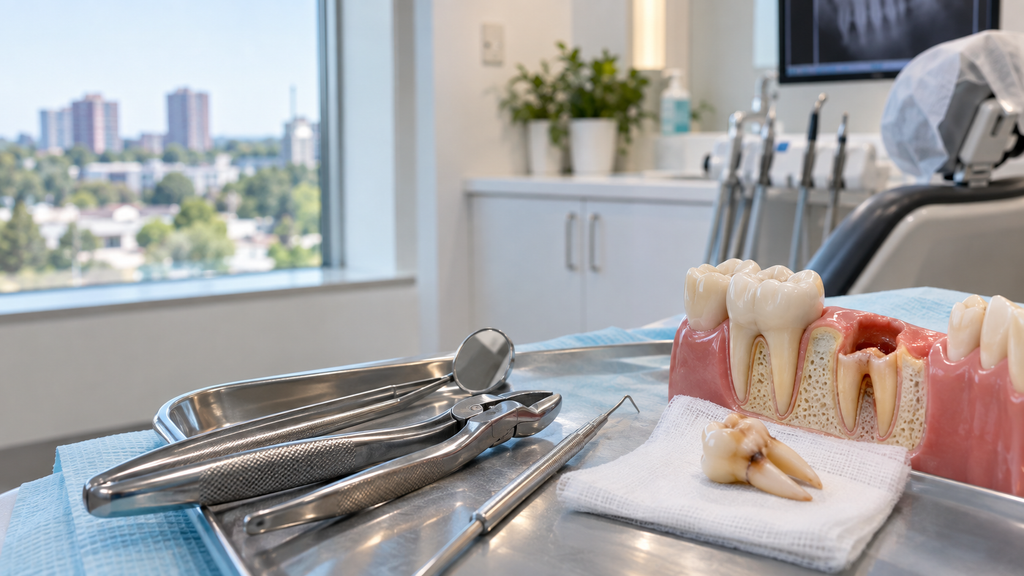
A dental extraction — sometimes called a dental removal by dental specialists — takes different amounts of time depending on the tooth. A non-surgical molar extraction where the tooth is fully erupted and the surrounding bone is intact typically takes 20 to 40 minutes from the administration of local anesthesia to final gauze placement. The dentist uses elevators to sever the periodontal ligament, then extraction forceps to remove the tooth from the socket. The socket is cleaned after tooth removal and a gauze pad is placed to help clotting. Most patients spend more time in the waiting room than in the chair.
A surgical molar extraction — required when a molar is impacted, fractured below the gum line, or when surrounding bone needs to be removed — takes 45 to 90 minutes. The oral surgeon or dentist makes an incision in the gum, removes a small amount of bone if needed, and may section the tooth into pieces before removal. Sedation anesthesia or general anesthesia may be used for complex cases or anxious patients. Wisdom tooth extraction almost always falls into this category — wisdom teeth typically emerge in the late teens to mid-twenties, and impaction is most common in this age group.
Day-by-Day Recovery Timeline
Recovery from molar extraction follows a consistent pattern across most cases. Individual timelines vary based on the complexity of the surgical site, the patient’s age, oral health, and whether dry socket or infection develops.
Day 1: Bite down on the gauze pad placed at the surgical site for 30 to 45 minutes. Change the gauze pad if it becomes saturated — continued gentle pressure is the most effective way to control bleeding. Expect some bleeding and oozing for the first few hours; this is normal. Apply an ice pack to the jaw in 20-minute on, 20-minute off intervals to manage swelling and limit bruising. Rest for the remainder of the day — physical exertion increases blood flow and can restart bleeding. Do not rinse, spit forcefully, or use a straw — any action that creates suction or pressure in the mouth disrupts blood flow to the forming blood clot and risks dry socket. Eat soft foods only: yogurt, soup, mashed potato, scrambled eggs. Take prescription pain medicine or over-the-counter NSAIDs like ibuprofen as directed. Do not wait for severe pain to start before taking pain medicine — staying ahead of the pain is easier than catching up.
Days 2–4: Swelling peaks around day two to three then gradually decreases. Bruising may appear on the jaw and cheek. Pain typically decreases over several days and should be manageable with prescription medicines or ibuprofen. Rinse the mouth gently with warm salt water starting day two — do not rinse forcefully. The instruction is to gently rinse only; vigorous movement in the mouth delays healing — delay healing is the direct clinical consequence — by reducing blood flow to the extraction socket. Continue soft foods. Avoid tobacco use — smoking delays healing by reducing blood flow to the extraction socket.
Days 5–7: Swelling and pain should be significantly reduced. Most patients return to normal diet by day five to seven, avoiding hard foods — do not eat hard or crunchy food on the extraction side. The extraction socket is partially closed by day seven. A bad taste or mild odour from the healing socket is normal as tissue regenerates.
Days 8–14: Soft tissue healing is complete in most cases by day 10. The gum tissue closes over the socket. At this point most patients have no pain and can eat normally. Nearby teeth and adjacent teeth may feel slightly sensitive — this resolves on its own.
Week 3 onward: The underlying jawbone begins remodelling. Full bone healing takes up to four months. During this period the socket gradually fills with new bone. If dental implants are being considered to replace the removed tooth, this healing period is when implant eligibility is assessed.
The Exception — Dry Socket
Dry socket (alveolar osteitis) is the most common complication after molar extraction and occurs when the blood clot that forms in the tooth socket is dislodged or dissolves before the wound has healed. It occurs in 2% to 5% of all extractions but is significantly more common after lower molar and wisdom tooth removal. When dry socket develops, causing severe pain that typically begins two to four days after extraction and can last for several days. The dentist may pack the socket with a medicated dressing and prescribe additional medication to manage the pain while the socket heals.
Why Dry Socket Happens
The blood clot that forms in the extraction socket is the foundation of healing — it protects exposed bone and nerves while the body grows new tissue to close the wound. Tobacco use, drinking through a straw, spitting forcefully, rinsing aggressively in the first 24 hours, oral contraceptives, and poor oral health all increase the risk of clot disruption.
How to Spot Dry Socket Early
Severe pain at the extraction site two to four days after surgery that is not relieved by prescription pain medicine — especially when accompanied by a bad taste or visible empty socket — is the primary sign. Contact your dentist immediately.
When Molar Extraction Takes Longer
Several complications extend procedure time and recovery beyond the standard timeline. Oroantral communication — where a maxillary molar extraction creates an opening between the mouth and the sinus cavity — occurs with upper teeth extractions and requires immediate management. Inferior dental nerve injury is a known risk with lower molar removal, with incidence ranging from 0.35% to 8.4% depending on root proximity to the nerve. Post-operative bleeding that does not respond to gauze pressure may require local hemostatic agents. Infection at the surgical site — signalled by increasing pain, swelling, and fever after day three rather than decreasing — requires prompt treatment. Left untreated, infection spreads to other teeth, the gums, and surrounding bone, causing other problems that require more extensive dental surgery.
How This Plays Out in Ontario
In Ontario, a straightforward molar extraction at a general dentistry clinic typically costs $150 to $350. A surgical procedure involving an oral surgeon costs $300 to $600 or more depending on the complexity of the root anatomy and whether bone removal is required. Most insurance plans cover 50% to 80% of extraction fees under basic or major restorative benefits — confirm your specific coverage at your consultation appointment before treatment begins.
Patients in Ontario who present with tooth decay that has destroyed the molar crown, gum disease causing significant bone loss around the root, or a fracture below the gum line are typically advised toward extraction rather than restoration when the tooth cannot be saved. Periodontal disease is the second most common reason for molar extraction after tooth decay — bone loss from advanced gum disease can destabilise a molar to the point where no restorative treatment is viable. In these cases, the conversation shifts immediately to replacement options: a dental implant, a dental bridge, or in some cases a partial denture.
At Delta Park Dental in Brampton, tooth extractions are performed by Dr. Shilpa Diwan and the clinical team under local anesthesia, with sedation options available for patients who need it. For complex cases involving impacted wisdom teeth or teeth requiring oral surgery beyond standard extraction, referral to a specialist is arranged promptly so treatment is not delayed. Patients referred to dental specialists receive a full brief on what to expect, expected recovery timeline, and how to manage the extraction socket at home before the specialist appointment.
The Ontario Dental Association fee guide does not fix what a clinic must charge, but most clinics in the Brampton and Mississauga area price within the range above for routine extractions. Emergency molar removal — where the tooth is causing acute dental pain and cannot wait for a scheduled appointment — is managed through emergency dentistry in Brampton at Delta Park Dental on the same day where scheduling allows. Patients who delay treatment for a severely decayed or infected molar risk the infection spreading to the jawbone, surrounding bone, and adjacent teeth, which significantly increases the scope and cost of treatment.
For wisdom tooth extraction specifically, anesthesia choice depends on the extraction difficulty and the patient’s comfort level. Most straightforward extractions use local anesthesia with no sedation. For surgical extractions, nitrous oxide sedation is the most common option in a general dentistry setting. Patients who are anxious about the procedure should discuss sedation options at the consultation appointment.
What People Get Wrong
The most common mistake patients make after a molar extraction is rinsing too aggressively on day one. The instruction to gently rinse starting day two is specific — not day one, and not forcefully. Any action that creates suction or pressure in the mouth in the first 24 hours risks dislodging the blood clot and triggering dry socket.
The second is underestimating recovery time for impacted lower molars. An upper molar extraction and a lower impacted wisdom tooth extraction are not comparable procedures. The lower jaw has denser surrounding bone, the tooth roots are closer to the inferior alveolar nerve, and the surgical procedure is more complex. Patients who plan to return to physically demanding work the next day after a lower molar surgical extraction often have a hard time doing so and should plan for at least two to three days off.
Third: confusing normal healing with infection. A bad taste in the mouth during the first week of healing is expected as the tissue regenerates — this is not infection. Infection presents with increasing pain and swelling after day three, fever, and pus at the surgical site. If symptoms are worsening rather than improving after day three, that is the signal to call the dental clinic, not to wait.
Fourth: patients who assume their oral health prior to extraction does not affect recovery. Patients with existing gum disease, untreated tooth decay on adjacent teeth, or poor oral hygiene before extraction have a slower and more complicated recovery than patients who arrive in good baseline oral health. Pre-extraction cleaning and infection control, when time allows, meaningfully reduces the risk of post-operative infection.
Fifth: expecting the removed tooth replacement conversation to happen after extraction rather than before. Understanding what a dental bridge looks like on an adjacent tooth, and what a dental implant involves at the molar site, helps patients make an informed decision before extraction rather than facing the gap and regretting delayed replacement later.
How Delta Park Dental Approaches Molar Extraction
At Delta Park Dental, every tooth removal begins with a consultation appointment to take x-rays, assess the removed tooth’s root anatomy, evaluate surrounding bone, and confirm whether the extraction can be completed in the clinic or requires referral to an oral surgeon. Patients receive a written post-operative care sheet and a follow-up call at 48 hours for surgical extractions.
For patients presenting with tooth decay, periodontal disease, or gum disease that has progressed to the point where saving the tooth is not viable, we discuss replacement options before the extraction takes place. For most patients, the choice is between a dental bridge and a dental implant. The guide on what a dental crown looks like helps patients understand the restoration on adjacent teeth, and a dental implant at the molar site requires jawbone healing of three to four months after extraction before implant placement. Knowing this timeline before the extraction helps patients plan.
Post-extraction follow-up is a standard part of our protocol. If signs of dry socket, infection, or other complications emerge between appointments, patients are seen promptly. Complications do not resolve on their own and early intervention prevents the situation from worsening. Patients discharged after a surgical extraction receive written instructions covering what to eat, how to manage bleeding, how to identify early signs of dry socket, and when to call the clinic.
Sedation is available at Delta Park Dental for patients who experience dental anxiety or who require a more complex oral surgery. We accept most insurance plans and assist with direct billing. Emergency molar extractions are accommodated the same day where possible through our emergency dentistry in Brampton service. Call +1 905-494-0094 to discuss your case.
Frequently Asked Questions
How painful is a molar extraction?
With local anesthesia, you should feel pressure and movement but not pain during the procedure — the anesthesia numbs the area completely. If you feel pain during the extraction, tell the dentist immediately so additional anesthesia can be administered. Post-operative pain is typically managed with NSAIDs like ibuprofen or prescription pain medicine for the first two to three days. Most patients rate post-extraction discomfort as moderate — uncomfortable but manageable — and find it resolves significantly by day three to four. Severe pain after day two that is getting worse, not better, may indicate dry socket.
When can I eat normally after a molar extraction?
Start with soft foods immediately after surgery — yogurt, soup, and mashed foods are ideal for the first 48 hours. By days three to five most patients can eat soft but more substantial foods. Avoid hard foods on the extraction side until the socket has closed, typically day seven to ten. Return to a full normal diet is usually possible by the end of the second week.
What are the reasons for molar extraction?
Tooth decay that has destroyed too much of the tooth to restore with a crown is the most common reason for molar extraction — the common reason that brings most patients to an extraction appointment is a molar that has deteriorated beyond repair. Severe periodontal disease causing bone loss around the molar root, a fractured tooth below the gum line, pulpal pathology that cannot be treated with root canal, and impacted wisdom teeth are the other primary indications for extraction. Overcrowding requiring space for orthodontic treatment is a less common reason for molar removal in adults.
How long does it take before I can get a dental implant?
After molar extraction the jawbone needs three to four months to heal before a dental implant can be placed. Immediate implant placement at the time of extraction is possible in select cases where bone volume and quality allow, but is not routine for molar sites. A consultation appointment after extraction assesses healing and confirms when implant placement can proceed.
About Delta Park Dental
Delta Park Dental is a family and cosmetic dentistry clinic in Brampton, Ontario, performing tooth extractions, dental surgery, and emergency dentistry in Brampton for patients across the GTA. Led by Dr. Shilpa Diwan, the clinic provides tooth removal, dental implants, and a full range of oral health treatments under one roof. Direct billing and CDCP accepted. Call +1 905-494-0094.
Service Area
Delta Park Dental is at 215 Delta Park Blvd, Unit 104, Brampton, ON L6T 0H9, serving Brampton, Mississauga, Caledon, Woodhill, and the wider GTA. Hours: Mon 10am–4pm | Tue–Sat 10am–6pm.
Next Step
Experiencing dental pain or need a molar extracted? Book through our emergency dentistry in Brampton service for same-day assessment where available. Call +1 905-494-0094 or book online at deltaparkdental.com/contact-us/.
For the full range of dental services at our Brampton clinic, visit the Delta Park Dental services page.