




The information on this page is for general educational purposes only.
Please consult your dentist for advice specific to your oral health.
A dental bridge is a fixed restoration that replaces one or more missing teeth by anchoring artificial teeth to the natural teeth or implants on either side of the gap. In Ontario, it is one of the most common solutions for tooth loss. This guide covers all four types, how long each lasts, and when a bridge is the better choice over implants. Delta Park Dental provides dental bridges in Brampton for patients across the GTA.
Key Takeaways
• A dental bridge typically replaces one to four missing teeth in a row and lasts 10 to 15 years with proper care
• There are four main types: traditional, cantilever, Maryland (resin-bonded), and implant-supported — each suited to different clinical situations
• Traditional bridges cost between $2,000 and $5,000 per unit; insurance may cover part of the cost
• Bridges restore chewing ability, speech function, and prevent adjacent teeth from shifting into the gap
• Dental implants last longer and preserve bone, but bridges are faster, less invasive, and work when bone grafting is not an option
What a Dental Bridge Is, Defined
A dental bridge is a permanent dental restoration used to replace missing teeth — a replacement tooth or multiple teeth held in place by anchoring to the structures around the gap. It consists of one or more artificial teeth — called pontics — held in place by crowns cemented onto the abutment teeth on either side of the gap. The result is a fixed replacement that looks, feels, and functions like natural teeth, restoring chewing ability and helping patients speak properly and eat comfortably — giving them a confident smile and supporting long-term dental health.
How a Dental Bridge Works
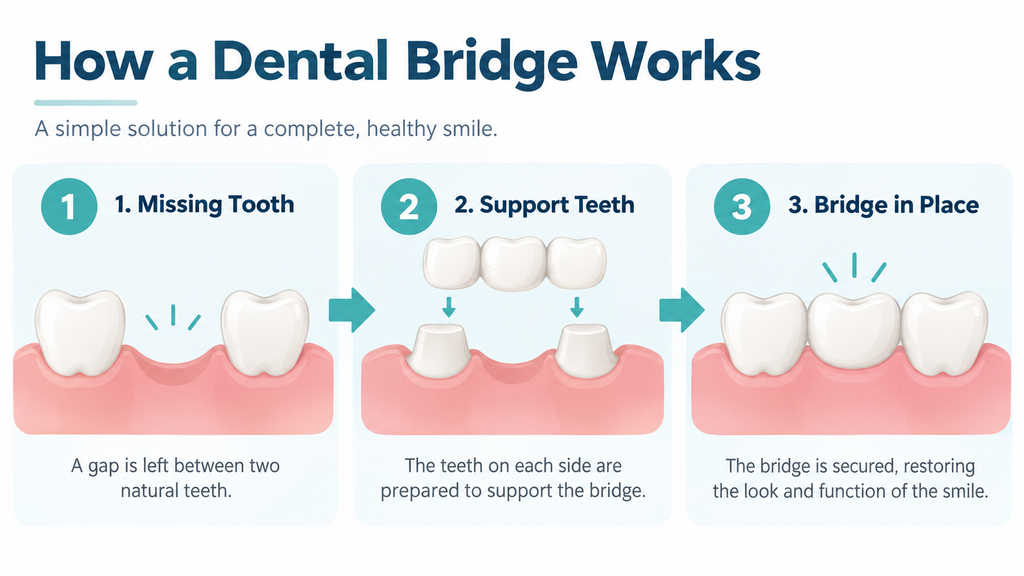
A dental bridge relies on surrounding support structures for stability — either healthy natural teeth reshaped into abutments, or dental implants placed in the jaw. The bridge is custom-made in a dental laboratory to match the shape, size, and colour of the patient’s remaining teeth. The lab creates a restoration from porcelain, ceramic, metal alloy, or a combination — each material chosen to suit the location of the new bridge, the chewing forces it will bear, and the patient’s cosmetic dentistry goals.
Step by Step
Stage One — Assessment and Preparation
The dentist examines the gap, surrounding teeth, and overall oral health. Local anesthesia is administered. The abutment teeth — the healthy teeth on either side of the gap — are reshaped by removing a layer of enamel to create space for the crowns that will anchor the bridge. Impressions are taken and sent to a dental laboratory, where a custom bridge is fabricated.
Stage Two — Temporary Bridge
While the dental lab creates the permanent bridge, a temporary bridge is placed over the prepared abutment teeth, the exposed teeth surfaces, and the gum line. These supporting teeth are protected from sensitivity and damage during the waiting period. This stage typically lasts one to two weeks depending on the dental laboratory’s turnaround.
Stage Three — Fitting the Final Bridge
Once the dental lab returns the custom bridge, the temporary bridge is removed. The new bridge is checked for fit, bite, and colour match against the remaining natural teeth. Adjustments are made before the final bridge is cemented permanently onto the abutment teeth. The final result is a restoration that is indistinguishable from natural teeth in daily life.
The Main Types of Dental Bridge
There are four main types of dental bridges, each suited to different clinical situations depending on the location of the missing tooth, how many teeth are missing, and the condition of the neighboring teeth.
Type Comparison Table
| Type | Anchor | Best for | Limitations |
| Traditional | Crowns on both adjacent teeth | Single or multiple missing teeth with two healthy abutments | Adjacent teeth permanently reshaped |
| Cantilever | Crown on one adjacent tooth | Front tooth with one healthy neighbour | Higher fracture risk; avoid for molars |
| Maryland / Resin-bonded | Wings bonded to back of adjacent teeth | Single front tooth; minimal prep needed | Can debond; not for heavy bite areas |
| Implant-supported | Dental implants in the jawbone | Multiple adjacent missing teeth; no healthy abutments | Requires bone density; longer timeline |
Traditional Dental Bridges
Traditional dental bridges are the most common solution for replacing a missing tooth when healthy teeth exist on both sides of the gap. Two crowns are placed on the abutment teeth — the adjacent teeth on either side — and one or more pontics hang between them to fill the space. Traditional bridges can replace a single missing tooth or up to four missing teeth in a row. They are strong, durable, and well-suited to back teeth that bear significant chewing load. Dental lab fees for bridges range from $100 to $900 in addition to the clinical fee.
Best Suited To
Patients with one or more missing teeth who have two healthy adjacent teeth on either side of the gap, adequate oral health, and no significant bone loss. Traditional bridges are a proven common solution for both front teeth and back teeth.
Limitation to Know
The abutment teeth must be permanently reshaped — this is irreversible even if the bridge is later replaced.
Cantilever Bridges
Cantilever bridges are anchored on only one side — to a single abutment tooth — rather than on both sides of the gap. They are used when there is only one healthy tooth next to the gap, most often toward the front of the mouth. Because they place lateral stress on a single supporting tooth, cantilever bridges are generally not recommended for back teeth or areas subject to heavy chewing forces. They suit situations where a traditional bridge is anatomically impossible.
Best Suited To
Patients missing a front tooth with only one healthy neighboring tooth available for support. Often used where adjacent teeth are already crowned.
Limitation to Know
Lateral chewing force on one abutment increases the risk of fracture over time — not recommended for molar replacement.
Maryland Bridges (Resin-Bonded Bridges)
Maryland bridges — also called resin bonded bridges — use metal or porcelain wings bonded to the back surfaces of the adjacent teeth rather than full crowns. This means the neighboring teeth require minimal reshaping, making Maryland bridges the most conservative option. They work well for front teeth where chewing forces are lower. Maryland bridges may be less expensive than traditional options and are a good choice when preserving healthy tooth structure is a priority.
Best Suited To
Patients with a single missing front tooth and healthy adjacent teeth who want to avoid reshaping those teeth. Also used as a long-term temporary bridge while an implant site heals.
Limitation to Know
Bonded wings can debond over time — Maryland bridges have a higher long-term failure rate than traditional bridges under heavy bite forces.
Implant-Supported Bridges
An implant bridge — also called implant supported bridges in cases covering multiple teeth — relies on dental implants placed in the jawbone rather than on adjacent natural teeth for support. For patients replacing multiple adjacent missing teeth, implant-supported bridges may be the best option — they do not require reshaping of healthy neighboring teeth, and adequate jawbone density is critical for their success. The bridge is fixed to the implants with abutment connectors, creating a stable, long-lasting restoration.
To understand how implants work beneath the bridge, the guide to what are the 3 types of dental implants explains the options in detail.
Best Suited To
Patients missing two or more adjacent teeth with sufficient jawbone density who want to avoid altering healthy surrounding teeth. Ideal when no healthy abutment teeth exist.
Limitation to Know
Requires adequate jawbone density and, in some cases, bone grafting before placement. Treatment time is longer than for conventional bridges.
Dental Bridge vs. Implant, Denture, and Crown
A dental bridge fills the gap left by one tooth or several — and it is often confused with three other restorations. Getting the distinction right matters in daily life because it affects treatment planning, cost, and long-term outcomes.
It is not a dental implant. A dental implant is a titanium post surgically placed into the jawbone that replaces the root of a missing tooth. A bridge sits above the gum line and anchors to existing teeth or implants — it does not integrate with the jaw. Implants do not put stress on nearby teeth the way a conventional bridge does. Implants last longer and preserve bone, but require surgery, adequate bone density, and a longer treatment timeline. Implant placement often involves an oral surgeon and a healing timeline of several months.
For a direct comparison, the dental bridge vs implant guide covers the clinical trade-offs in detail.
It is not a partial denture. Partial dentures are removable appliances that sit on the gum and are taken out for cleaning. A bridge is fixed — cemented in place — and is cleaned like natural teeth. Many patients choose a bridge specifically to avoid the daily inconvenience of a removable partial denture.
It is not a veneer or crown. A dental crown covers a single damaged tooth. A veneer improves the appearance of the front surface of a tooth. A bridge replaces one or more teeth that are missing entirely.
Who a Dental Bridge Is For in Ontario
A dental bridge is well-suited to patients who have lost one or more teeth and want a fixed, non-surgical solution that restores function quickly. At Delta Park Dental, our general dentists offer
At Delta Park Dental, our general dentists offer dental bridges in Brampton for adults of all ages — from patients who have lost a front tooth in an accident to those managing tooth loss from decay or gum disease.
Bridges work particularly well when:
• Two healthy abutment teeth exist on either side of the gap
• The patient prefers a faster treatment timeline than implants require
• Bone loss makes implant placement difficult without bone grafting
• Cost is a consideration — bridges are typically less expensive than implant supported options
• The patient’s general health or personal preferences make surgery less suitable
A well-maintained bridge can last from 5 to 15 years or longer depending on care, the location of the bridge, and several factors including the patient’s oral hygiene habits. Patients who grind their teeth place significantly more force on the bridge and abutment teeth, which shortens the lifespan. A night guard is often recommended to protect the bridge in these specific dental cases. Regular dental visits, professional cleanings, and the use of floss threaders to clean beneath the pontic all contribute to better oral health and longer bridge life.
For patients who are good candidates for implants — sufficient bone density, good general health, and no preference against surgery —
For patients who are good candidates for implants, dental implants offer a longer-lasting result and preserve the jawbone over time.
Dental implants in Brampton dental implants in Brampton are available at Delta Park Dental for patients who qualify.
If you are weighing both options, the decision often comes down to how many teeth are missing, the condition of the surrounding teeth, and whether the long-term investment in implants fits your daily life and budget. The right bridge for your overall health depends on the full clinical picture.
Frequently Asked Questions — Dental Bridge FAQs
How long does a dental bridge last?
A dental bridge lasts 10 to 15 years on average with proper care — some last longer with excellent care. The main factors are oral hygiene, bite forces on the bridge, and how well the abutment teeth hold up over time. Bridges on front teeth tend to last longer than those on back teeth, which take more chewing load. Using floss threaders daily to clean beneath the pontic, avoiding hard foods on the bridge, and attending regular dental visits and professional cleanings are the simple habits that determine whether a bridge lasts a decade or two.
What is the dental bridge procedure like?
The dental bridge procedure typically takes two appointments. At the first, local anesthesia is applied, the abutment teeth are reshaped, impressions are taken, and a temporary bridge is placed. At the second, the temporary bridge is removed and the custom bridge from the dental lab is cemented permanently. Most patients report mild sensitivity for a few days after each appointment.
When does a dental bridge beat an implant?
A dental bridge beats an implant when speed, cost, or suitability for surgery matters. Bridges are placed in two appointments and do not require bone grafting or a healing period of several months. For patients with bone loss who cannot support implants without significant surgery, a bridge is often the practical and clinically sound choice. If healthy adjacent teeth exist and the patient is not a strong implant candidate, a bridge is often the right bridge — and frequently the more accessible option for patients in Ontario.
How many teeth can a dental bridge replace?
A dental bridge can replace one to four missing teeth in a row. The practical limit is structural — patients with a longer bridge are advised to avoid hard foods that place excessive lateral load on the pontics. The longer the bridge span, the more stress is placed on the abutment teeth or implants supporting it. For patients missing more than four adjacent teeth, implant supported bridges or a combination of implants and bridges is typically recommended by the dental professional.
About Delta Park Dental
Delta Park Dental is a family and cosmetic dentistry clinic in Brampton, Ontario, providing
Delta Park Dental is a family and cosmetic dentistry clinic in Brampton, Ontario, providing dental bridges in Brampton and a full range of general dentistry, cosmetic dentistry, and restorative treatments. Dr. Shilpa Diwan and the team serve patients across Brampton, Mississauga, Caledon, and the surrounding GTA communities. The clinic accepts most insurance plans, offers direct billing, and is a registered Canadian Dental Care Plan provider. Call +1 905-494-0094 to speak with the team directly.
Service Area
Delta Park Dental serves Brampton and surrounding communities including Mississauga, Caledon, and Woodhill. The clinic is located at 215 Delta Park Blvd, Unit 104, Brampton, ON L6T 0H9 — accessible from major routes across the GTA.
Next Step
If you are missing one or more teeth and want to understand your options, book a consultation for dental bridges in Brampton at Delta Park Dental. Our team will assess whether a bridge, implant, or combination approach is right for your specific dental situation. Call +1 905-494-0094 or book online at deltaparkdental.com/contact-us/.
For the full list of dental services available at our Brampton clinic, visit the Delta Park Dental services page.
Every smile is different. For accurate information and personalized treatment options,
book a consultation with the team at Delta Park Dental.