



The information on this page is for general educational purposes only.
Please consult your dentist for advice specific to your oral health.
When you are missing a tooth, the two most effective permanent solutions are a dental bridge and a dental implant — and the right choice depends on your jawbone health, budget, how many teeth are missing, and how long you want the solution to last. A dental implant is often considered the gold standard for tooth replacement; a dental bridge is faster, less invasive, and suits patients who cannot or do not want surgery. This guide gives you a clear comparison so you can make an informed decision.
At Delta Park Dental, patients across Brampton regularly ask about the dental bridge vs implant decision. The guidance here reflects real clinical experience treating both — and honest recommendations based on individual patient needs.
What Is a Dental Bridge?
A dental bridge is a fixed restoration that uses adjacent teeth to support a replacement tooth or teeth across the gap. It consists of one or more pontics — artificial replacement teeth for replacing missing teeth — anchored to dental crowns placed over the abutment teeth on either side of the gap. Dental bridges dentists recommend cover several types of dental situations, from a single missing tooth or teeth to spans of several teeth.
Dental bridges typically replace one to four consecutive teeth, completed in two to three visits using local anesthesia. Traditional dental bridges require healthy teeth on both sides of the gap. Other types include a cantilever dental bridge — one abutment tooth only — and maryland bridges, also called resin bonded bridges, which use metal wings bonded to neighboring teeth without crowning them. Implant supported bridges use implants as anchors.
Dental bridges can be completed without surgery, making them suitable for patients avoiding invasive procedures. They are fabricated in a dental laboratory from dental impressions, meaning the dental lab produces a custom-fitted restoration matched to surrounding teeth.

What Is a Dental Implant?
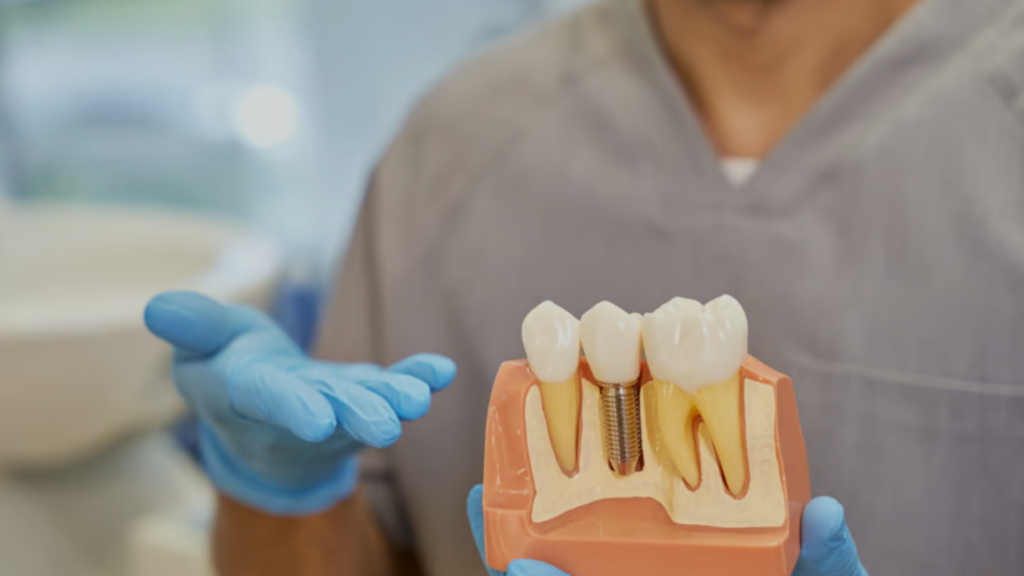
A dental implant is an artificial titanium post placed surgically into the jawbone. Once new bone grows around the implant and it fuses with the jawbone over several months, an artificial tooth — a crown — is attached to the implant. A single implant replaces one tooth without affecting surrounding teeth. One implant can also support implant supported bridges spanning multiple positions.
Dental implants preserve existing bone, maintain gum tissue health, and do not require alteration of nearby teeth. They behave like real teeth — patients can eat, brush, and floss daily as they would with natural teeth. Dental implants can last 20 years to a lifetime with proper care and have a success rate of 92 to 98 percent over ten years.
Dental Bridge vs Implant — Side-by-Side Comparison
| Feature | Dental Bridge | Dental Implant |
| Surgery required | No | Yes — implant surgery |
| Treatment time | 2–3 visits, few weeks | 3–6 months including healing |
| Affects other teeth | Yes — abutment teeth crowned | No — standalone artificial tooth |
| Prevents bone loss | No | Yes — preserves jawbone |
| Lifespan | 5 to 15 years | 20 years to lifetime |
| Success rate | Reliable with healthy abutment teeth | 92 to 98% over 10 years |
| Upfront cost | Lower | Higher |
Note: Insurance coverage for dental implants varies by plan. Bridges may require more frequent maintenance than implants.
When Is a Dental Bridge the Right Choice?
Dental bridges are a viable option when there is insufficient bone density for implants, when the patient wants a faster solution, or when budget is the primary consideration. Dental bridges usually cost less upfront than implants and are completed in a few weeks without a surgical healing process.
A bridge also suits cases where exposed teeth on either side already need crowns — addressing multiple issues in one treatment. Cantilever bridges suit single-sided gaps. Maryland bridges are used for front teeth where adjacent healthy teeth should not be altered.
The key limitation: bridges do not prevent bone loss in the area of the missing tooth. The jawbone at that site gradually resorbs over time, which affects the gum line appearance and the stability of remaining teeth on either side of the gap.
When Is a Dental Implant the Right Choice?
A dental implant is the better long-term investment for most adults with enough bone and healthy gums. Implants preserve existing bone and reduce future bone loss — a clinical advantage bridges cannot offer. They do not affect remaining teeth or nearby teeth — no abutment teeth are crowned.
The implant site heals fully before the crown is attached to the implant. Most patients find dental implant procedures more comfortable than expected under local anesthesia. Soreness and swelling after dental implants are normal and manageable with over-the-counter medication.
Bone grafting may be needed if the jawbone is insufficient at the implant site — this adds to the timeline but opens implant treatment to patients who would otherwise not qualify. A dental specialist or oral surgeon assesses whether the jawbone can provide more support through x rays before treatment begins, confirming everything is working properly before proceeding.
What Most Patients Get Wrong About Dental Bridge vs Implant
“A bridge is just as good long-term.”
Dental bridges typically last 5 to 15 years before replacement. Implants last 20 years to a lifetime with proper care. Beyond lifespan, bridges do not prevent bone loss beneath the missing tooth. The installation of dental bridges can also lead to potential decay and gum disease in the supporting abutment teeth if oral hygiene lapses — meaning neighboring healthy teeth can be affected over time.
“Implants are too painful.”
Most patients do not feel pain during placement with thorough local anesthesia. Getting a dental bridge should not hurt due to anesthesia use either — but the difference is the healing process after implant surgery. Discomfort in the days after implant placement is typically handled with standard pain relief. Most patients find the procedure far more manageable than anticipated.

“Bone loss rules out implants.”
Bone grafting can rebuild the jawbone at the implant site. Many patients told they are not candidates elsewhere qualify after grafting. A general dentist or oral surgeon will assess x rays and determine whether grafting is appropriate. Do not assume bone loss is a permanent barrier without a professional assessment of how many teeth are involved and what the implant site shows.
How Does Each Procedure Work?
Dental Bridge Procedure
Abutment teeth are prepared, dental impressions taken, and a temporary bridge placed while the dental lab fabricates the permanent restoration. At the second appointment the bridge is fitted and cemented under local anesthesia. Most patients feel no pain during the visit.
Dental Implant Procedure
Implant surgery places the titanium post into the jawbone under local anesthesia. New bone grows around the implant over several months, after which an abutment and crown are attached. The total process takes three to six months, longer if bone grafting is required. A general dentist or dental specialist manages the treatment plan.
What Brampton Patients Should Know
At Delta Park Dental, patients across Brampton regularly ask about the dental bridge vs implant decision. Patients with gum disease, insufficient jawbone, or chronic diseases affecting healing require assessment before either treatment can be recommended. Patients in good overall health with enough bone are typically better served long-term by a single implant or implant supported bridges — even if the upfront cost is higher. For patients who want faster resolution or are not surgical candidates, a traditional bridge remains a reliable, natural looking smile solution. We review x rays, assess remaining teeth and gum tissue, and build a treatment plan around your clinical situation and your goals.
When Should You See a Dentist About a Missing Tooth?
Book a consultation if:
• You have experienced tooth loss and want to understand your replacement options, or need a new bridge to replace a failing restoration
• You have been told you cannot get implants due to bone loss — a second opinion may reveal grafting options
• A dental bridge you currently have is failing or causing gum problems
• You want to replace missing teeth before bone loss progresses further
Why Choose Delta Park Dental for Bridge or Implant Treatment?
We provide both dental bridges and dental implants for Brampton patients, with an honest assessment of which suits your situation before treatment begins.
• Full consultation including x rays, jawbone and gum tissue assessment
• Bridge and implant surgery in a patient-first environment
• Bone grafting in-office when required
• Transparent costs and realistic timelines
• CDCP and major insurance accepted
• Good oral hygiene guidance, reminders to see a dentist regularly, and professional cleanings included in aftercare
Whether you need a fixed bridge or a single implant, our team will help restore your natural looking smile and protect your long-term oral health.
Frequently Asked Questions: Dental Bridge vs Implant
Q1. What is the main difference between a dental bridge vs implant?
A dental bridge uses adjacent abutment teeth to support a replacement tooth across the gap. A dental implant places an artificial titanium post in the jawbone — no surrounding teeth are altered. Implants preserve jawbone and last longer; bridges are faster, less invasive, and suit patients with insufficient bone or those avoiding surgery. Both are effective — the right choice depends on your clinical situation.
Q2. Does bone grafting make me eligible for dental implants?
Yes. Bone grafting rebuilds the jawbone at the implant site when bone loss has occurred. Many patients told they are not candidates qualify after grafting is assessed through x rays by a general dentist or oral surgeon. Grafting adds time to the treatment plan but opens implant treatment to patients who would otherwise need a bridge. Do not assume bone loss permanently rules out implants.
Q3. How long does the dental bridge procedure take?
The dental bridge procedure typically takes two to three appointments over a few weeks. Abutment teeth are prepared, dental impressions taken, and a temporary bridge placed while the dental lab makes the permanent restoration. At the second appointment the bridge is fitted and cemented under local anesthesia. There is no surgery, so recovery is faster — most patients return to soft foods within days.
Q4. Do dental crowns always need to be placed on abutment teeth for a bridge?
Traditional dental bridges require dental crowns over the abutment teeth on either side of the gap. Maryland bridges are an exception — they use metal wings bonded to the back of neighboring teeth rather than full crowns, making them more conservative. Cantilever bridges use only one abutment tooth. The type of bridge your dentist recommends depends on the location, how many teeth are missing, and the health of nearby teeth.
Q5. Can a general dentist perform a dental implant or bridge procedure?
Most general dentists perform dental bridge procedures routinely. Simple single implant cases are also within the scope of many general dentists. More complex cases — involving bone grafting, significant gum disease, or multiple implants — are typically coordinated with an oral surgeon or dental specialist. At Delta Park Dental, your general dentist will assess your case and determine the right level of care, referring to a specialist when needed.
Delta Park Dental | Brampton, Ontario | Family, Cosmetic & Emergency Dentistry
Every smile is different. For accurate information and personalized treatment options,
book a consultation with the team at Delta Park Dental.